Trades or Construction Business in Australia? Why Progress Claims Break Basic Bookkeeping
You didn’t get into construction because you love spreadsheets.
You got into it because you’re good at building things. Managing crews. Winning jobs. Getting projects across the line.
But somewhere between the first invoice and the fifth active site, something shifted.
The tools are still in the ute. The crew is still on site. The work is still getting done.
But the books? The books have quietly stopped making sense.
If that sounds familiar, you’re not bad at bookkeeping. You’ve just outgrown the bookkeeping system you started with.
The Real Problem Isn’t Bookkeeping, It’s Progress Claims
Most off-the-shelf bookkeeping setups are built for a simple transaction pattern: you sell something, you invoice it, you get paid.
Construction and trades businesses don’t work like that.
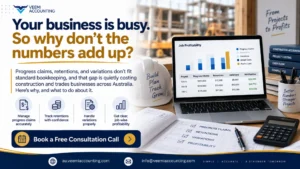
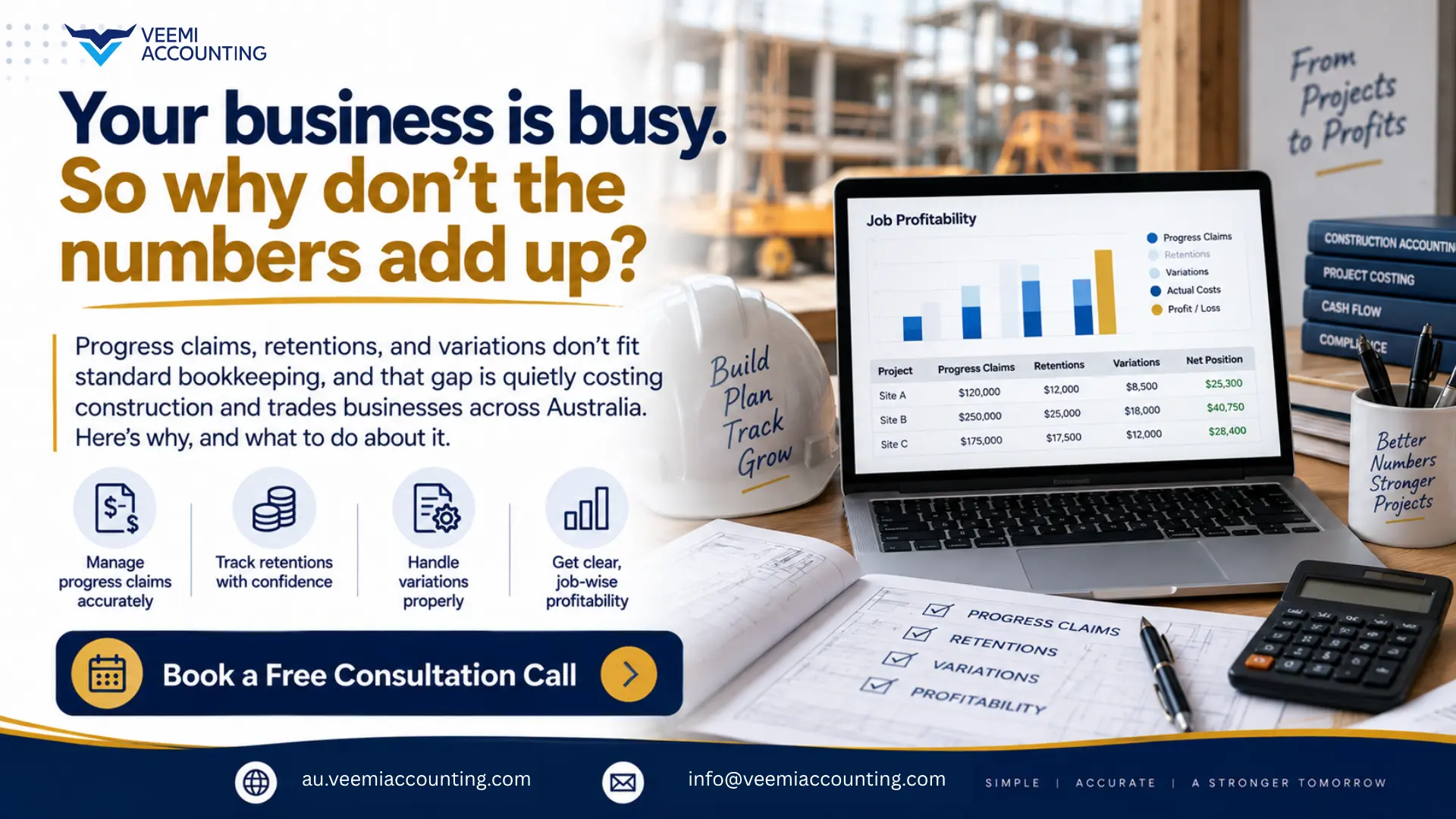
👉 You’re not selling a product. You’re delivering a project in stages, over months, often with variations, retentions, and multiple parties involved before a single dollar clears.
That’s where progress claims come in, and it’s exactly where basic bookkeeping starts to break.
👉 A $180,000 job might be split into five or six claims.
👉 Each claim might be assessed, queried, partially approved, or delayed by the client or head contractor.
👉 Retention money might be withheld until practical completion, sometimes months later.
👉 Variations might be agreed on-site verbally, then forgotten by the time invoicing happens.
None of that fits neatly into a “sale = invoice = payment” model. So the bookkeeping either gets forced into a shape it wasn’t designed for, or it gets left messy and dealt with “later.”
Later usually means at tax time. Under pressure. With gaps.
Later usually means at tax time. Under pressure. With gaps, and gaps like that are often how a BAS lodgment deadline gets missed in the first place.
Why This Quietly Damages Profitable Businesses
Here’s the part that catches a lot of business owners off guard.
👉 You can be genuinely busy, genuinely skilled, and still be losing money, and not know it, because the numbers aren’t reflecting reality.
That’s what happens when progress claims aren’t tracked properly.
👉 You invoice a claim, but the accounting software books it as full revenue on the day it’s raised, even though it might not be paid for 60 or 90 days.
👉 Retention amounts sit as “income” on paper, even though that cash is locked away and won’t hit your account for months.
👉 Work-in-progress on active jobs isn’t reflected anywhere, so your profit and loss statement is really just telling you a story about invoicing timing, not actual job performance.
The result? You look at your numbers, a nd they don’t match how the business feels.
“We’re flat out. So why does the bank account say we’re struggling?”
That question is one of the most common things construction business owners say, and it’s rarely about how hard the team is working. It’s about how the books are structured underneath it.
How Much Additional Work Can Your Current System Realistically Handle?
Think about your business eighteen months ago versus now.
👉 More sites.
👉 More subcontractors.
👉 More variations.
👉 More retention held across more jobs at once.
More sites. More subcontractors. More variations. More retention held across more jobs at once.
More crew on the books usually means more room for payroll reporting errors to creep in too, a separate problem, but one that grows for the same reason.
Growth is supposed to feel like momentum. But for a lot of trades and construction businesses, growth quietly turns into operational strain, not because the work is too hard, but because the systems underneath weren’t built to scale with it.
⚠️ This is the moment where a lot of business owners either push through with spreadsheets and hope, or realise the reporting they’re relying on to make decisions is already out of date.
Neither is a great place to run a business from.
What Job-Costed, Progress-Claim-Aware Bookkeeping Actually Looks Like
The problem is no longer just “getting the books done.” The problem is getting books that actually tell you the truth about each job.
✅ Revenue recognised in line with actual project stage, not just invoice date
✅ Work-in-progress tracked separately from completed, billed work
✅ Retention amounts clearly identified and monitored, not buried inside general revenue
✅ Job-level profitability visible, so you know which projects are actually making money, and which ones are quietly bleeding it
✅ Variations captured and reconciled properly, not chased down after the fact
👉 When bookkeeping is structured around how construction actually works, something shifts. You stop reacting to numbers and start using them to make decisions: which jobs to chase again, which clients are slow payers, where your margins are actually holding up.
That’s a very different relationship with your finances than most trades business owners currently have.
A Common Pattern Worth Recognising
Most construction business owners don’t realise their bookkeeping has fallen behind reality until one of a few things happens.
👉 A big job wraps up, and the “profit” on paper doesn’t match what actually landed in the bank.
👉 Tax time arrives, and there’s a scramble to reconstruct what happened across a dozen jobs.
👉 A lender or accountant asks for job-costed reporting, and it simply doesn’t exist.
👉 Retention money that was “counted on” turns out to still be sitting with the client, unpaid.
None of these are signs of a badly run business. They’re signs of a business that has outgrown a generic bookkeeping approach, and needs something built for the way construction actually moves money.
Where Veemi Accounting Fits In
Progress claims, retentions, and job-costing sit at the intersection of construction operations and technical accounting, and it’s exactly where a lot of businesses start to feel stretched.
👉 Building out proper job-costed reporting takes time most construction businesses don’t have to spare internally.
👉 Understanding how to treat WIP, retention, and variations correctly takes construction-specific expertise, not just general bookkeeping knowledge.
👉 As your project load grows, the reporting demands grow with it, often faster than your internal capacity can keep up.
This is where Veemi Accounting works as a back-office extension of your existing finance function.
✅ We build and maintain job-costed bookkeeping systems designed around progress claims, retentions, and variations, not generic sales cycles.
✅ We support accurate WIP tracking, so profitability reporting reflects what’s actually happening on each job, not just what’s been invoiced.
✅ We provide bookkeeping, accounting support, and tax preparation support that scales alongside your business, without you needing to build an internal team from scratch.
✅ Where deeper financial oversight is useful, our fractional CFO support helps translate the numbers into decisions, pricing, cash flow timing, and job selection.
👉 The goal isn’t to replace how you run your business. It’s to make sure the numbers underneath it are finally telling you the truth, so decisions about pricing, staffing, and which jobs to chase are based on real data, not a guess.
If your reporting has been feeling a step behind your actual workload, that’s usually not a “try harder” problem. It’s a systems problem, and it’s a solvable one.
Frequently Asked Questions
Because standard bookkeeping software is built around a simple invoice-and-pay cycle, while construction income arrives in stages, is subject to retention, and often includes variations that aren’t finalised until months later. Without adjustments, the books show a distorted picture of real performance.
Retention is a portion of each progress claim withheld by the client or head contractor, typically until practical completion or the end of a defects liability period. If it isn’t tracked separately, it can look like income that’s already been received when it’s actually still outstanding.
If you can’t quickly answer “which jobs are actually profitable right now,” or your profit and loss doesn’t match how busy the business feels, that’s usually a strong sign your current bookkeeping isn’t structured for construction-specific reporting.
In most cases, yes. Job-costing, WIP tracking, and retention management can be layered into existing accounting software with the right setup and ongoing oversight, rather than requiring a full system replacement.