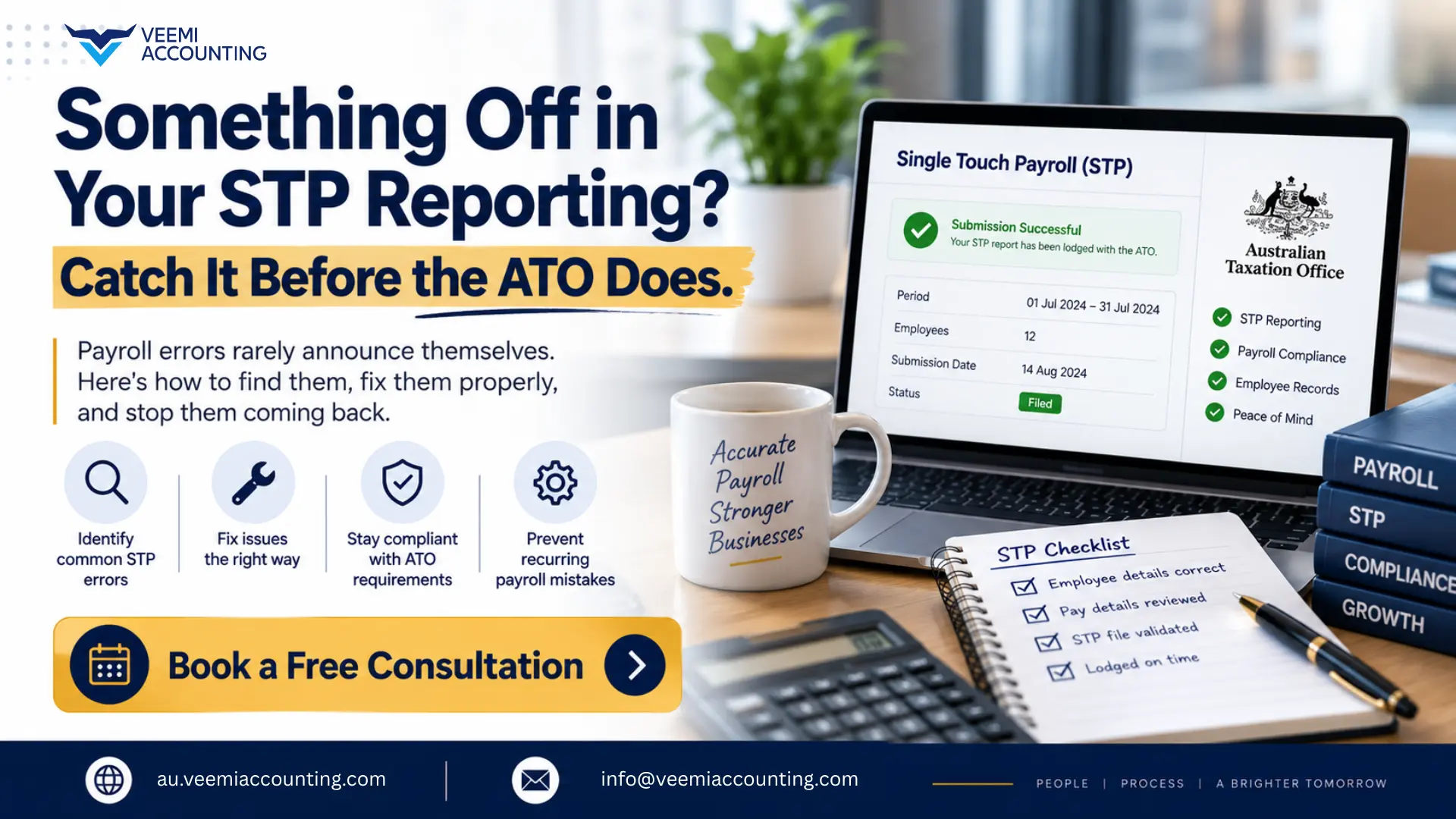
Single Touch Payroll Reporting Errors in Australia? How to Fix Them Before the ATO Notices
Payroll errors rarely announce themselves.
The wages are paid. The payroll report is lodged. Everyone moves on.
Then someone notices that an employee’s year-to-date figures don’t match, a payment has been classified incorrectly, or payroll records don’t reconcile with what was reported to the ATO.
Suddenly, a routine payroll task becomes a compliance problem.
For Australian businesses, Single Touch Payroll errors are often less about carelessness and more about process. When payroll becomes busy, small inconsistencies can easily slip through. And the longer they remain unnoticed, the harder they can be to fix cleanly.
Why Single Touch Payroll Errors Happen
Single Touch Payroll (STP) reporting connects payroll information with ATO reporting. That makes accurate payroll data more important than ever.
But think about what happens inside a growing business.
👉 A new employee is added.
👉 A payment category is changed.
👉 Someone makes a manual payroll adjustment.
👉 Payroll software is upgraded or replaced.
👉 Different people handle payroll and bookkeeping.
Each individual change may seem harmless. Together, they can create reporting discrepancies.
The problem is no longer simply paying employees correctly. The problem is making sure the right information reaches the ATO in the right way.
Common Single Touch Payroll Errors to Check
Incorrect Employee Information
One of the first things to check is whether employee year-to-date information in your payroll system matches what has been reported through STP.
If the figures don’t match, don’t simply make another adjustment and hope the numbers balance.
👉 First identify where the discrepancy started.
The ATO provides specific processes for correcting STP reporting information, including employee-level errors.
How to Check If Your STP Reports Are Accurate
You don’t need to wait for the ATO to flag something. A quick internal check each quarter can catch most issues before they compound:
👉 Compare year-to-date gross payments in your payroll software against what was actually reported through STP for each employee.
👉 Check that superannuation guarantee amounts calculated in payroll match what’s shown in your STP report.
👉 Confirm any employees who left mid-year have a correctly finalised STP record, not an open one still accruing figures.
👉 Review any manual adjustments made outside the normal pay run — these are the most common source of reporting mismatches.
👉 Spot-check a handful of individual pay events against the STP submission rather than only looking at totals.
This kind of review takes a fraction of the time it takes to unwind a reporting error that’s been repeating for six months.
Incorrect Payment Classification
A payment can have the correct dollar amount but still be reported incorrectly if it has been assigned to the wrong category.
This is why payroll reviews should ask more than “Did we pay the employee correctly?”
They should also ask “Did we report the payment correctly?”
Duplicate or Incorrect Payroll Records
Software changes can create additional risks. Employee IDs, payroll IDs and software configurations need to be managed carefully during system transitions.
⚠️ A payroll migration that appears successful on the surface can still create reporting issues underneath.
What to Do When You Find a Payroll Error
The worst response is panic. The better response is a structured review.
- Find the Source
Identify exactly what is wrong.
👉 Which employee is affected?
👉 Which pay event created the discrepancy?
👉 Is the issue with the amount, classification or employee information?
👉 Does the problem affect one employee or several?
- Reconcile Before Correcting
Compare the payroll records with the STP information and relevant accounting records.
This step matters because the STP error may only be a symptom of a larger process problem.
👉 Fixing the report without fixing the process can simply create the next error.
- Correct the Reporting Information
Once the cause is understood, use the appropriate correction process through your payroll software.
The ATO provides guidance for correcting STP reporting issues and recommends reviewing lodged reports and addressing errors when identified.
If you’re uncertain about the correction required, getting professional payroll or tax advice before making another adjustment can prevent additional complications.
Don’t Wait Until Year-End
One of the biggest mistakes businesses make is treating payroll reconciliation as a year-end activity.
By then, a small error may have been repeated across multiple pay cycles.
👉 Regular payroll reviews make problems smaller.
👉 Documented processes make corrections easier.
👉 Clear ownership reduces last-minute scrambling.
This becomes even more important in 2026. From 1 July 2026, Payday Super introduced additional payroll and reporting requirements, including STP reporting of qualifying earnings and super liability information.
In other words, payroll accuracy is becoming an even more important operational discipline.
What Happens If You Don’t Fix a Payroll Error
It’s worth understanding what’s actually at stake if an STP error goes unaddressed, since that shapes how much urgency it deserves.
At a basic level, incorrect STP data can affect an employee’s income statement, which flows through to their own tax return and, in some cases, government benefit calculations. An employee querying a discrepancy on their end-of-year summary is often the first sign a business has that something’s gone wrong internally.
There’s also a compliance dimension. The ATO uses STP data as part of how it monitors superannuation guarantee compliance and PAYG withholding. Repeated or unresolved discrepancies can prompt closer review, particularly once Payday Super requirements are fully in effect and super payment timing is being reported alongside wages.
And practically, the longer an error sits, the more pay cycles it touches. A misclassified payment type caught in the first pay run is a five-minute fix. The same error found eight pay runs later means eight periods of records to review and correct, not one.
None of this means every STP discrepancy is a crisis. Most aren’t. But treating an error as worth investigating the same week it’s noticed, rather than at the next quiet moment, tends to be the difference between a quick correction and a drawn-out reconciliation project.
Getting Help With Payroll Compliance
If STP errors keep turning up, or you’re not confident your current process would catch one before it becomes a pattern, it’s worth getting your payroll reviewed properly rather than continuing to patch individual entries.
Veemi Accounting supports payroll services for Australian businesses, including Single Touch Payroll processing and compliance, alongside bookkeeping and BAS preparation support.
Frequently Asked Questions
Yes. The ATO provides processes for correcting information that has already been reported through STP. The correct method depends on the type of error.
No. Where an error is identified, it is generally better to investigate and correct it promptly rather than allowing discrepancies to accumulate.
Look for the underlying cause first. A common payroll configuration or process issue may have affected multiple employees, so correcting the root cause is important before repeating individual corrections.
Payday Super commenced from 1 July 2026, adding new payroll and reporting requirements. This makes accurate payroll data, timely processing and reliable review procedures increasingly important for employers.
A quarterly review is generally enough to catch most issues before they become significant. Businesses going through a payroll software change, rapid hiring, or a period of high staff turnover should check more frequently, since these are the situations most likely to introduce errors.