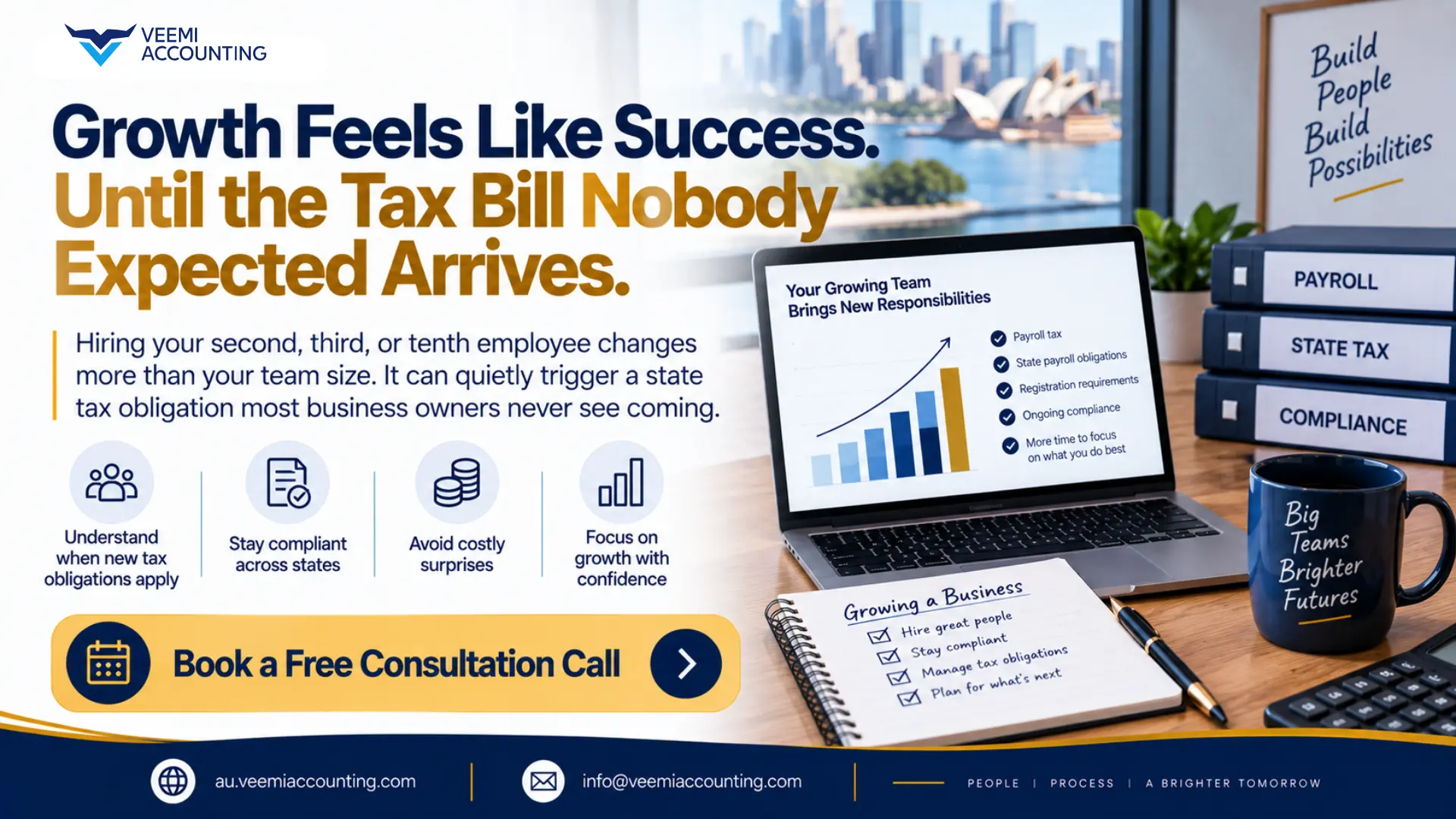
Growing Past One Employee in Australia? Why Payroll Tax Registration Catches Businesses Off Guard
You’ve just hired your second, third, or tenth employee.
You’re thrilled. Revenue is up. The team is growing. Everything looks like success on paper.
And then, months later, a letter arrives from the state revenue office.
Suddenly “growth” doesn’t feel like a win. It feels like a compliance headache nobody saw coming. If this sounds familiar, you’re not alone. It’s one of the most common, and most avoidable, surprises in Australian small business tax.
➜ The problem isn’t that your business grew. The problem is that nobody told you growth has a tax trigger attached to it.
Payroll Tax Isn’t Federal, and That’s Exactly Why It Gets Missed
Most business owners understand PAYG withholding. They understand super. Those obligations are federal, consistent, and baked into every payroll conversation from day one.
Payroll tax is different.
👉 It’s a state-based tax, not a federal one.
👉 Every state and territory sets its own threshold and its own rate.
👉 There’s no single national number you can just “remember.”
That’s exactly why it slips through the cracks. A business that’s fully compliant with the ATO can still be non-compliant with its state revenue office, and have no idea.
How much do you actually know about the payroll tax registration threshold in your state? For most business owners, the honest answer is: not much, until they’re already over it.
What the Payroll Tax Registration Threshold Actually Looks Like
The payroll tax registration threshold in Australia varies significantly depending on where your business employs staff.
As a general guide for the 2026-27 financial year:
👉 New South Wales sits around $1.2 million in annual wages, taxed at 5.45% above that mark.
👉 Queensland’s threshold sits near $1.3 million.
👉 South Australia’s threshold is closer to $1.5 million.
👉 Victoria, Western Australia, Tasmania, the ACT, and the Northern Territory each apply their own separate figures.
⚠️ These numbers shift with state budgets, so always confirm the current figure against your relevant state revenue office before relying on them.
Here’s the detail that trips people up: the threshold isn’t just base salary.
👉 Superannuation, allowances, bonuses, fringe benefits, and even certain contractor payments can all count toward “taxable wages.”
You might look at a payslip and think you’re nowhere near the threshold, while your actual taxable wage base tells a completely different story.
Why “One Employee” Is Often the Real Turning Point
Here’s the part that matters most: it’s rarely the first hire that triggers payroll tax.
It’s the second. Or the third. Or the moment you bring on a part-time contractor who starts looking a lot like an employee.
That’s the moment your total wages start creeping toward six figures, then seven. And that’s usually the moment nobody’s watching.
Most business owners are focused on delivery, cash flow, and client relationships. Payroll tax registration isn’t on the radar, because it’s never been explained as a growth issue. It’s filed away as “some tax thing for big companies.”
It isn’t. It’s a self-assessed tax, which means the responsibility to register sits entirely with you, not with the ATO, and not with the state, until they come looking.
What Happens When a Business Misses the Threshold
⚠️ Late registration doesn’t just mean back-paying the tax owed.
👉 It can mean interest charges building month over month.
👉 It can mean penalty tax layered on top of the original liability.
👉 It can mean a multi-year retrospective assessment, since state revenue offices actively audit and share data.
For a growing business, that’s not a small inconvenience. That’s a cash flow event nobody budgeted for.
What happens when a good year turns into an unexpected six-figure liability you never planned for? That’s the conversation worth having before it happens, not after.
How to Stay Ahead of It as You Grow
The good news is that this is one of the easier compliance risks to get ahead of, once you know to look for it.
👉 Check your total wage base against your state’s threshold each time you take on a new employee or contractor, not just once a year.
👉 If you operate across more than one state, make sure wages are apportioned correctly rather than assessed against a single threshold.
👉 Review contractor payments specifically for payroll tax purposes. A payment that’s fine for income tax purposes can still count toward your taxable wages.
👉 Get your accountant or bookkeeper to flag this as part of your regular reporting, not as a once-a-year afterthought.
Getting ahead of this is far less stressful than untangling a multi-year assessment after the fact. It also connects to a broader pattern worth watching. Just as single touch payroll errors tend to creep in as a business grows and hires more people, payroll tax exposure grows quietly alongside it, for exactly the same reason: more moving parts, less time to track them all manually.
Getting Help With Payroll Tax Monitoring
Monitoring your wage base against a shifting state threshold, especially if you operate across state lines or use a mix of employees and contractors, isn’t something most business owners have time to track properly while running the business day to day.
Veemi Accounting supports growing Australian businesses with bookkeeping, payroll monitoring, and tax preparation, so obligations like payroll tax registration get flagged before they become a surprise, not after. The same consistent record-keeping that keeps payroll tax on your radar is also what keeps you ahead of other state and ATO obligations, like avoiding a missed BAS lodgment deadline further down the track.
Book a Consultation